In the spatial design of Minecraft, curved geometry presents a perennial struggle. Builders routinely tackle horizontal circles and spheres, but they frequently overlook the mathematical forces of gravity that shape the vertical lines of our world. When building a suspension bridge, a rustic jungle rope bridge, a series of sagging electrical wires in a factory district, or the intricate rigging of an 18th-century galleon, the flat, straight lines generated by standard linear interpolation look sterile and implausible. They lack tension, weight, and life.
To convey structural realism, the human eye demands the presence of gravity. However, Minecraft's engine does not calculate physical tension for decorative structures. It is the responsibility of the builder to embed physics directly into the geometry of the blocks. The pinnacle of this gravity-bound geometry is the catenary curve.
Derived from the Latin word for "chain" (catena), a catenary curve is the natural shape that a hanging cord, chain, or cable assumes under its own weight when supported only at its ends. In this exhaustive, deep-knowledge guide, we will analyze the mathematical physics of catenaries, differentiate them from parabolic approximations, adapt hyperbolic equations into voxel coordinate systems, and lay out systematic blueprints for building flawless, gravity-defying curves in sandbox grids.
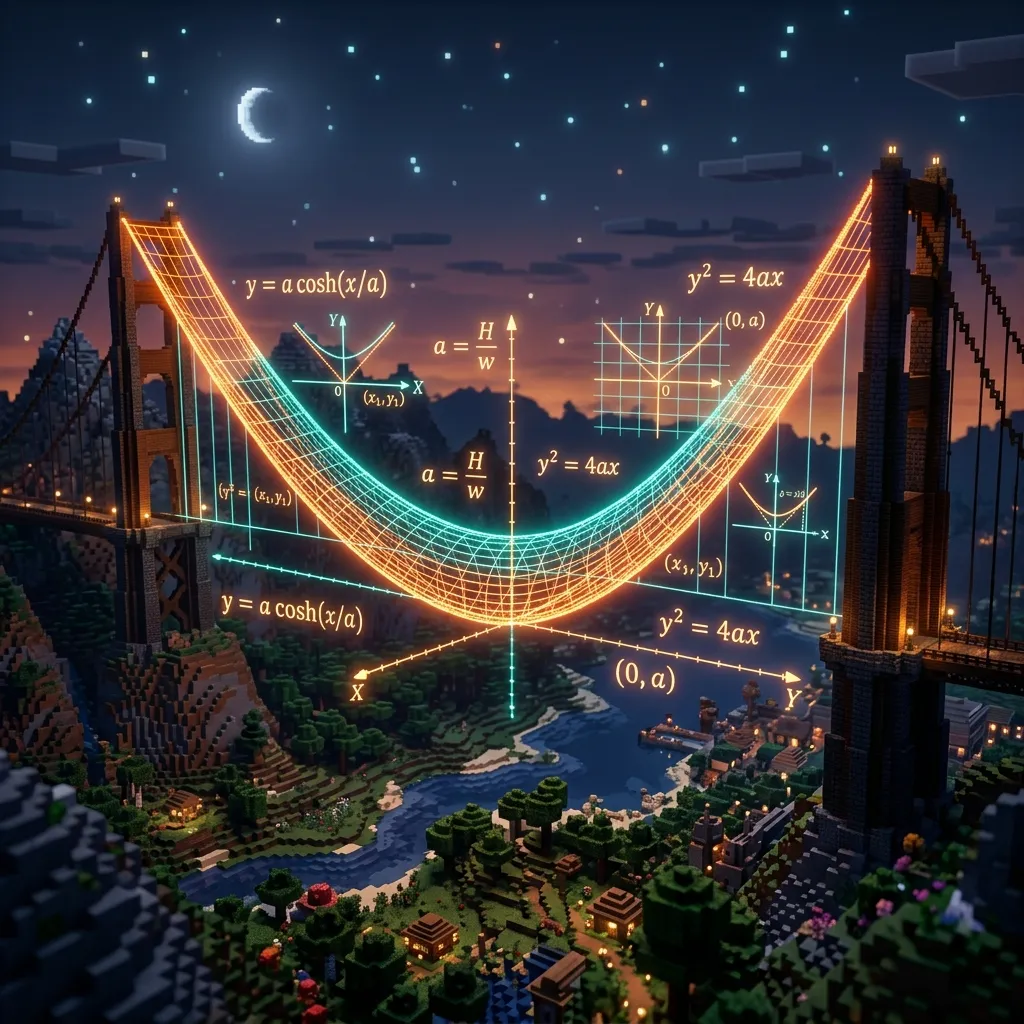
1. Hyperbola vs. Parabola: The Physics of Sagging
A common mistake among even seasoned builders is the assumption that any sagging loop is a simple parabola. In school, we are taught the classic quadratic equation $y = kx^2$, which describes the path of a projectile. In engineering, however, tensioned elements follow two distinct paths depending on how load is distributed:
| Curve Type | Mathematical Equation | Physical Condition | Visual Characteristics in Voxel Grid |
|---|---|---|---|
| Catenary | $y = a \cosh(x/a)$ | Hanging cable supporting ONLY its own weight. Uniform mass along the arc length. | Sharper, plunging droop near support anchors; flat, suspended trough at the center. |
| Parabola | $y = kx^2$ | Cable supporting a heavy, uniformly distributed horizontal load (e.g., a suspension bridge deck). | Gradual, continuous curve; more open and rounded sweep throughout the entire span. |
If you are building a simple, un-decked rope bridge (where players walk directly on the sagging element) or loose wires hanging between telephone poles, you must build a catenary. If you are building the massive steel suspension cables of a modern suspension bridge (like the Golden Gate Bridge), where vertical hangers transfer the uniform weight of a flat roadway to the main cables, you must build a parabola.
The visual difference is striking. A catenary plunges more aggressively from the anchors and holds a slightly flatter bottom because the weight of the cable is distributed along the actual curve, which is longer than its horizontal footprint. The parabola is a gentler, more even sweep. Using a parabola where a catenary belongs creates an uncanny visual dissonance—the brain immediately registers that the "rope" is under an unnatural distribution of forces.
2. The Catenary Equation Decoded
To plot a catenary curve, we must dissect its algebraic formula. The general Cartesian equation of a catenary centered on the y-axis is:
Where:
- $\cosh(u)$ is the hyperbolic cosine function, mathematically defined as the average of two exponential growth curves: $\cosh(u) = \frac{e^u + e^{-u}}{2}$.
- $a$ is the tension parameter (representing $T_0 / w$, where $T_0$ is the horizontal tension at the lowest point, and $w$ is the weight per block length of your cable). This parameter dictates the "slackness."
- $C$ is an arbitrary vertical offset constant used to align the lowest point of your curve with a specific height coordinate in your Minecraft world.
If the tension parameter $a$ is small, the exponential components grow rapidly as you move away from the center ($x=0$), resulting in a deep, sweeping drape with steep walls. If $a$ is large, the curve is highly tensioned and looks almost flat. By altering $a$, you can perfectly calibrate the visual weight of the cables, making heavy iron chains droop aggressively, while light copper wires stay taut.
3. Discrete Rasterization: Plotting Catenaries on a Voxel Grid
Translating the continuous hyperbolic cosine function into individual block placements requires a systematic rasterization approach. Because a computer monitor draws pixels on a grid, graphics programmers developed Bresenham’s algorithms. For the builder, we can achieve identical precision by sampling the continuous equation at integer $x$ intervals and calculating the ideal vertical $y$ coordinates.
The Step-by-Step Calculation Method
Let's map a sagging cable spanning a horizontal distance of $W$ blocks between two towers of equal height $H$, with the lowest point of the sag dipping to a depth of $D$ blocks below the suspension point.
Step 1: Set Up the Coordinate System
We center the lowest point of the curve at $x = 0$. The left anchor sits at $x = -W/2$, and the right anchor sits at $x = W/2$. The lowest point of the sag is at height $y_0$. Therefore, the anchors sit at height $y_{anchor} = y_0 + D$.
Step 2: Determine the Tension Parameter 'a'
Finding the exact value of $a$ that satisfies a specific width ($W$) and sag depth ($D$) is a transcendental problem. It requires iterative numerical approximation. However, for builders, we can approximate the relationship using the following formula:
a ≈ (W²) / (8 · D) - D / 6
For example, if you are building a rope bridge that spans a gap of 40 blocks ($W = 40$) and sags down by 10 blocks ($D = 10$), the formula yields: $a \approx (1600) / 80 - 1.67 \approx 18.33$.
Step 3: Calculate Block Placements
For every integer $x$ from $-W/2$ to $W/2$, calculate the height $y$ using the formula:
y = a · cosh(x / a) + (y_0 - a)
Here, $y_0 - a$ acts as our constant $C$ to anchor the absolute bottom of the curve at our target coordinate $y_0$. Calculate the value and round to the nearest whole integer: Y_block = Round(y).
4. Practical Scaling Tables and Proportions
To save you from executing transcendental algebra while active in the game, the table below provides optimized coordinates and parameter pairings for standard scale builds. These have been pre-computed to minimize double-step artifacts and jagged transitions.
| Span Width (W) | Sag Depth (D) | Tension (a) | Voxel Pattern (Center outward to one tower) | Visual Quality |
|---|---|---|---|---|
| 15 blocks | 3 blocks | 9.0 | 3 flat, then 2 step-1s, 2 step-2s, 1 anchor | Highly smooth; minimal aliasing |
| 31 blocks | 8 blocks | 14.0 | 3 flat, then 4 step-1s, 4 step-2s, 3 step-3s, 2 anchors | Very fluid; excellent for rope bridges |
| 51 blocks | 15 blocks | 20.5 | 3 flat, then 6 step-1s, 6 step-2s, 5 step-3s, 4 step-4s, 2 anchors | Exceptional fidelity at architectural scale |
| 101 blocks | 35 blocks | 35.5 | 5 flat, 12 step-1s, 10 step-2s, 8 step-3s, 8 step-4s, 7 step-5s, anchors | Perfect continuous curve for mega-projects |
Note on "Step-N" Notation: A "step-1" means placing blocks in a single horizontal sequence (run of 1). A "step-2" represents vertical segments that are 2 blocks tall, which occur as the slope begins to exceed 45 degrees ($dy/dx > 1$) near the anchors. Near the center, horizontal intervals dominate ($dy/dx < 1$).
5. Architectural Applications
Once you command the mathematics of sagging curves, you can apply them to elevate your architectural designs across various genres:
🌉 Jungle Suspension Bridges
In medieval and tribal landscapes, suspension bridges should hang directly from thick support pillars. Use Spruce Fences for the primary walkway and calculated catenary profiles for the guide ropes. Avoid perfectly straight diagonal ramps; let the pathway bow naturally to make the structure feel dynamically integrated with the ravine.
🔌 Industrial Powerlines
Modern and steampunk cities depend on high-voltage lines. By running chains or iron bars in a gentle catenary drape between transmission towers, you inject industrial realism. A subtle sag makes the power grid look heavy, material, and dangerous.
⛵ Maritime Ship Rigging
Ships are defined by their curves. The sails and rigging of a pirate ship are subjected to immense wind force and gravity. Applying tight, calculated catenary arcs to the black coal blocks or fences representing the ropes creates a profound illusion of swelling wind pressure.
🏛️ Neoclassical Banners
For grand temple corridors and cathedral facades, sweeping banners of wool or concrete powder look stiff if designed with flat triangles. Employing a catenary curve along the bottom of the banners makes the fabric appear realistically heavy and subject to gravity.
6. Texturing and Block Palette Selection for Tension Elements
A mathematically perfect curve can still look visually unappealing if the material palette does not reflect its physical scale. Since Minecraft blocks are 1x1 meter cubes, representing thin cables requires creative block choices:
- Micro-Cables (Chains and Iron Bars): For small-scale builds (under 30 blocks), standard blocks look too bulky. Fences, iron bars, and the specialized Chain block are ideal. The visual transparency of chains creates a thin, high-tension cable illusion.
- Medium Cables (Walls and Gates): For structures with spans between 30 and 70 blocks, transitioning from solid blocks to wall variants (like Stone Brick Walls or Deepslate Walls) near the steep towers, and using Fence Gates or Fences in the flat bottom sections, naturally mimics the tapered diameter of a physical cable under tension.
- Mega-Cables (Gradients and Anchors): For massive suspension spans (over 100 blocks), a single block line looks fragile. Build a multi-block thick cable using a core of Coal Blocks or Dark Gray Concrete, wrapped in Iron Bars. Use Grindstones or Anvils at the towers to serve as massive mechanical anchor points, grounding the tension visually.
7. Conclusion: The Master's Curve
Architectural mastery in Minecraft relies on tension. Straight lines are simple to build, but they are sterile. Circles and spheres show geometric coordination, but they are static. The catenary curve is dynamic—it is a visual dialogue between material weight and mathematical restraint. It commands the space it occupies, forcing the player to acknowledge the invisible presence of gravity.
Calculate Your Next Curve
Do not rely on guesswork. Map your towers, define your span, select your sag, and let hyperbolic geometry breathe life into your structural designs.
Open Circle & Curve GeneratorFrequently Asked Questions
Why does my catenary look like a sharp V-shape instead of a smooth U-shape?
This is a classic symptom of a tension parameter $a$ that is too small for the chosen width. If $a$ is under-calculated, the hyperbolic cosine function behaves as an extreme exponential, soaring straight up from the center. Ensure you are utilizing the approximation formula $a \approx (W^2)/(8D)$ to achieve a balanced, smooth transition at the bottom.
Can I approximate a catenary using a circle segment?
Only for extremely shallow curves (sag depth less than 10% of span width). As sag increases, a circle maintains a constant radius of curvature, whereas a catenary's curvature changes continuously, flattening at the center and sharpening near the anchors. At deeper droops, a circular segment will look visually wrong, appearing too rounded at the bottom.
How do I handle asymmetric catenaries (where support towers are at different heights)?
For uneven supports, the lowest point of the curve (the trough) shifts horizontally toward the lower tower. You must calculate the left and right halves of the curve independently as two separate catenaries sharing the same tension parameter $a$, meeting seamlessly at the horizontal offset where $dy/dx = 0$.
Are catenary curves structural arches in reverse?
Yes! This is a profound architectural concept known as the "hanging chain principle" pioneered by Robert Hooke and Antoni Gaudí (builder of the Sagrada Família). If you take a perfect catenary curve and invert it vertically, you create a pure compression arch. An arch built in this shape experiences zero shear stress—only pure compression—making it the strongest possible masonry arch. You can use inverted catenary calculations to build breathtaking stone arches in cathedral vaults.