In the architectural world, few structures capture the imagination quite like the geodesic dome. Popularized in the mid-20th century by visionary architect and polymath Buckminster Fuller, the geodesic dome is celebrated for its unparalleled strength-to-weight ratio and its ability to enclose vast interior volumes without internal supports. But what happens when we attempt to translate this pinnacle of continuous, spherical geometry into the rigid, Cartesian bounds of a voxel universe like Minecraft?
The transition from a continuous mathematical sphere to an Aliasing-prone voxel environment introduces a fascinating array of mathematical challenges. This exhaustive analysis delves into the underlying geometry, frequency mapping, and rasterization algorithms required to master geodesic architecture in Minecraft. Whether a structural engineer translating real-world schematics or an advanced builder aiming for the perfect sci-fi biodome, this guide serves as your definitive masterclass.
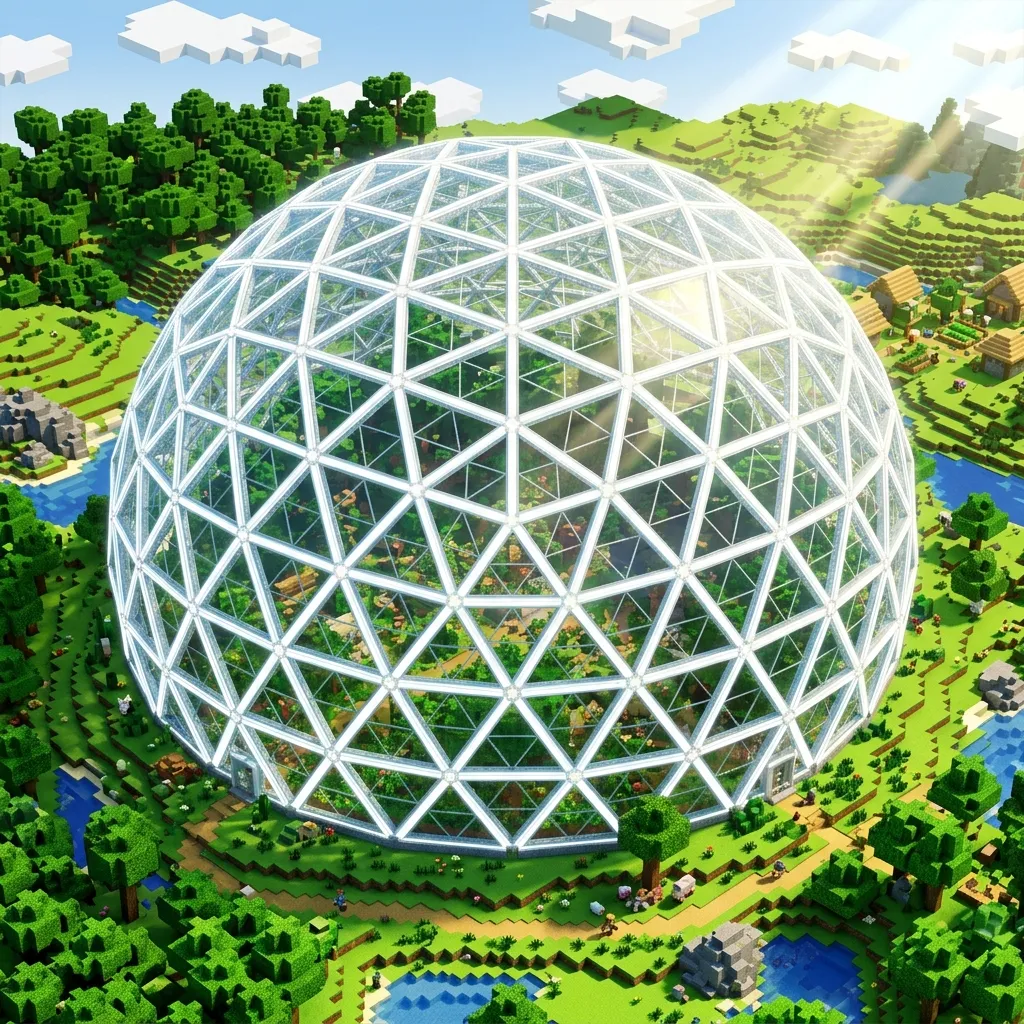
The Foundations: Icosahedral Geometry
Before examining voxel-specific optimizations, we must first dissect the geodesic dome in Euclidean geometry. Most geodesic domes are derived from a polyhedron—commonly the icosahedron. An icosahedron is a Platonic solid consisting of 20 equilateral triangular faces, 30 edges, and 12 vertices. The magic of the geodesic dome begins through a process called "subdivision" or "tessellation."
During tessellation, each of the original 20 triangles is subdivided into smaller triangles. The degree of this subdivision is known as the "frequency" (denoted as v). For instance, a 1v dome involves the original icosahedron faces mapped onto a bounding sphere. A 2v dome subdivides each original edge into two, transforming one large triangle into four smaller ones, and projecting these new vertices outward to intersect the spherical surface. A 3v dome produces nine triangles per original face, and so forth.
In the physical world, manipulating materials into these precise triangular facets relies on struts and hubs. The mathematical formula for calculating strut lengths involves intricate spherical trigonometry. However, in Minecraft, builders do not have the luxury of continuous rotational struts. Instead, we must approximate these triangles using 1x1x1 cubic discrete units. This limitation fundamentally alters the structural logic of the dome.
Voxelizing Spherical Geometry: The Rasterization Dilemma
Translating the vectors of a high-frequency geodesic dome into block placement requires 3D line rasterization algorithms. The most famous of these in computer graphics is the 3D Bresenham's line algorithm. This algorithm determines the coordinates of voxels that best approximate a straight line segment between two points in a 3D grid.
When constructing a geodesic dome in Minecraft, one would theoretically calculate the exact Cartesian coordinates (X, Y, Z) for the hubs (vertices) of the subdivided icosahedron, scaled by the desired radius r. Then, 3D Bresenham's is applied to draw the 'struts' (edges) connecting these vertices.
This process sounds straightforward mathematically, but the result is often aesthetically displeasing at smaller scales. Due to severe "aliasing" (the stair-step effect of pixels/voxels), intersecting diagonal struts can form clunky, asymmetrical clumps of blocks. For a geodesic dome to look structurally sound in Minecraft, it requires a massive radius. At a radius of 50 blocks or greater, the resolution of the voxel grid is sufficient to convey the intricate triangular latticework accurately without the aliasing overpowering the design.
Structural Integrity and The Visual Illusion of Triangles
The primary advantage of a geodesic dome in the real world is the load-bearing strength of the triangle. Since Minecraft does not simulate real-world physics for most blocks (barring sand, gravel, and concrete powder), the need for structural integrity is entirely visual and psychological. The goal is "architectural plausibility"—making the human eye believe the structure could support itself if gravity were suddenly enforced.
To achieve this, the frequency mapping of the dome must be carefully planned. A common phenomenon when rasterizing low-frequency domes (like 2v or 3v) in Minecraft is the "jaggies" problem. The triangular faces appear heavily distorted because they lack the sheer pixel density required to form straight diagonal edges. To combat this, master builders employ a technique called "vertex anchoring."
Vertex anchoring involves prioritizing the placement of the spherical vertices first. By creating prominent hubs—often using distinct block types, such as Sea Lanterns or Glowstone surrounded by darker materials—the builder provides the eye with strong reference points. The struts connecting these hubs are then built as thin, 1-block-wide lines. Even if the Bresenham rasterization creates jagged lines, the human brain interpolates the straight lines between the prominently marked vertices, "repairing" the geometry mentally.
The Golden Ratio, Spherical Coordinates, and Base 10 Mechanics
It is impossible to discuss icosahedrons without referencing the Golden Ratio (φ, approximately 1.618). The coordinates for the vertices of a regular icosahedron with edge length 2 centered at the origin are essentially cyclic permutations of (0, ±1, ±φ). This reliance on irrational numbers poses an immediate problem for the integer-bound coordinate system of Minecraft.
When mapping these coordinates to the Minecraft grid, the coordinates must be scaled and then rounded to the nearest integer. The mathematical operation looks like this:
X_mc = Round(X_sphere * r)
Y_mc = Round(Y_sphere * r)
Z_mc = Round(Z_sphere * r)
This rounding induces quantization error. In a 3v dome with a radius of 30, the maximum quantization error is 0.5 blocks per axis. Over the expanse of the dome, this error can lead to struts that appear slightly varying in thickness or angles that aren't perfectly symmetrical. To mitigate this, advanced architectural scripts calculate symmetrical quadrants and copy them over, rather than calculating the whole dome and subjugating the entire structure to random floating-point rounding inaccuracies. This ensures that the dome possesses four-way or even rotational symmetry, which is far more pleasing to human perception.
Dome Optimization: Performance and Lighting Dynamics
Building massive geodesic domes has significant implications for a Minecraft server's performance, specifically involving chunk updates, lighting computations, and rendering operations. Unlike a solid cube, a geodesic dome is composed mostly of air blocks interspersed with diagonal lines of solid blocks (or glass).
This "porous" geometry wreaks havoc on Minecraft's lighting engine. If a glass dome is constructed, sunlight propagates through hundreds of intersecting planes. Every time a block within the dome is updated, the engine recalculates the sky-light values traversing this complex web. Additionally, the game's frustum culling (the process of not rendering objects outside the player's view or behind solid walls) is largely ineffective inside a glass geodesic dome because there are no opaque walls to occlude distant chunks.
Consequently, professional builders optimize by employing specific material paradigms. For the 'struts', using solid, non-transparent blocks (like Quartz Pillars or Deepslate Bricks) reduces lighting updates compared to stained glass struts. Furthermore, aligning the base icosahedron so that its vertices sit exactly on chunks' borders can theoretically streamline sub-chunk rendering performance, although the exact performance delta is highly dependent on the host server's specific hardware and software configurations.
Psychological Impact of the Vaulted Ceiling
Beyond math and server mechanics, the geodesic dome introduces profoundly unique player psychology. Architectural research indicates that humans experience a sense of awe and "expansion" when entering high-vaulted, curved spaces. In Minecraft, where players spend vast amounts of their time in 3-block-high rectangular rooms, entering a massive geodesic dome with a vaulted roof generates an intense contrast.
The uninterrupted inner volume allows complete freedom of movement (especially with Elytra). However, it introduces a separate challenge: scale disorientation. Without corners, right angles, and intermediate support pillars, the brain struggles to accurately gauge distance and size within the dome. A player might think the dome ceiling is 20 blocks away when it is actually 60. To ground the space, interior design within these structures must rely on strong vertical elements—indoor trees, tiered fountains, or central beacons—that break up the empty volume and restore a sense of scale.
A Masterclass in Vertex Manipulation
Building geodesic domes by hand requires intense dedication. The traditional method involves using third-party 3D modeling software (like Blender or dedicated geodesic calculators), exporting the model, and transcribing it layer-by-layer into the game world, counting blocks across three axes simultaneously. Modern architectural tools and server plugins can automate the generation, but executing it flawlessly with a true understanding of the underlying mathematics is an art form.
One technique employed by mathematical builders is the "Class II" (or "Alternate") geodesic division. Unlike a standard Class I division where the subdivision lines run somewhat parallel to the edges of the original icosahedron faces, the Class II division rotates the subdivision grid by a specific angle. This fundamentally shifts the distribution of hexagons and pentagons that make up the dome's surface. In Minecraft, a Class II configuration can sometimes align better with the Cartesian axes, resulting in a cleaner rasterization process with fewer jagged edges directly along the X and Z planes.
Conclusion: Transcending the Block
The geodesic dome stands as a testament to the fact that Minecraft is not merely a game of stacking cubes, but a robust medium for mathematical exploration. By bridging continuous Euclidean geometry with discrete voxel mathematics, builders transcend the visual limitations of the block.
From the precise trigonometric calculations of spherical coordinate vectors to mitigating Bresenham aliasing, mastering the geodesic dome is an ultimate expression of architectural intent. It forces the builder to become mathematician, structural theorist, and server administrator all at once. The next time you witness a sprawling, perfect network of triangles shimmering against a Minecraft sunset, you will understand the deep, complex symphony of numbers that holds its beautiful illusion together.