How to Build Smooth Minecraft Circles & Arches with Stairs and Slabs
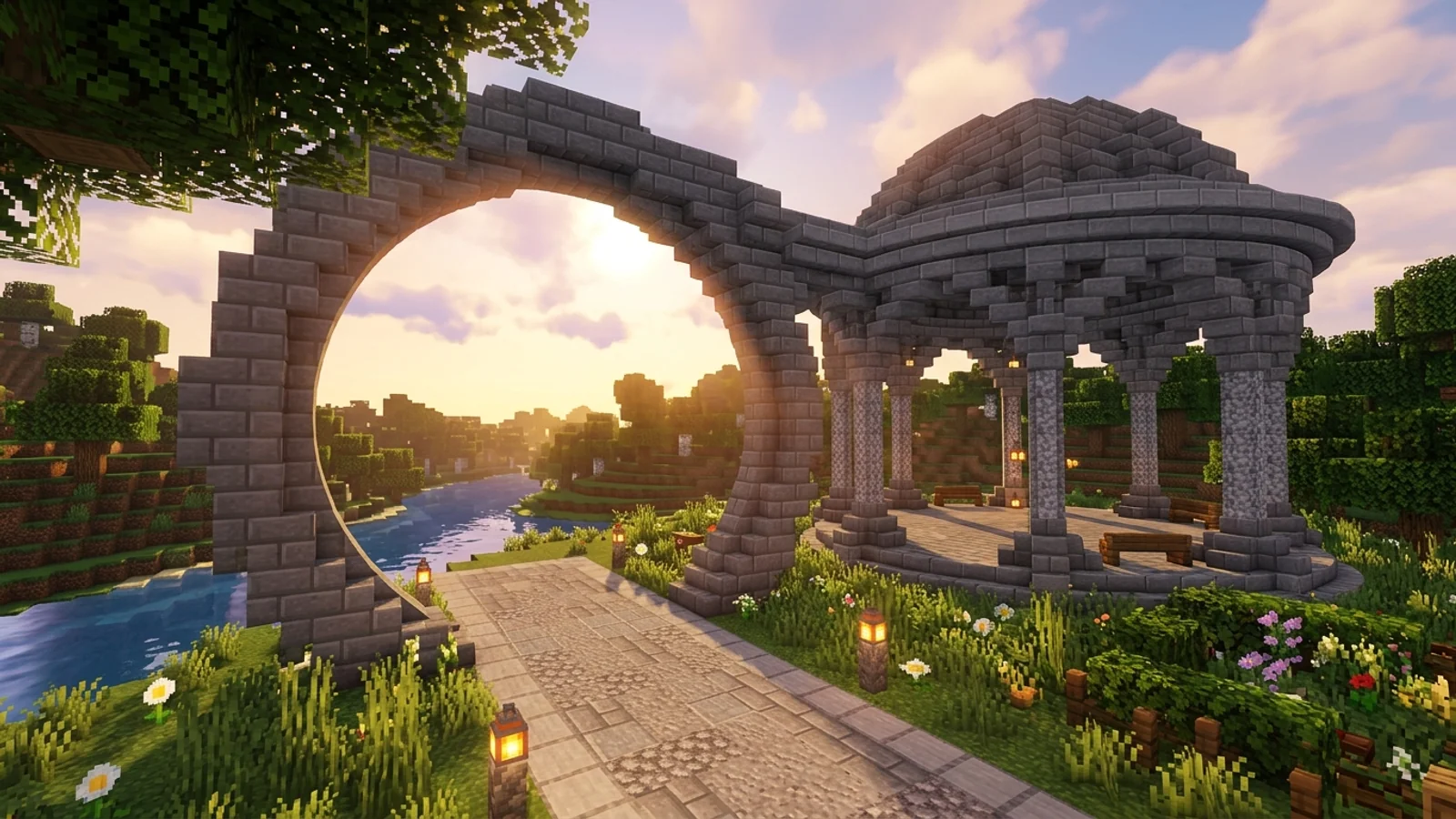
When you generate a circular template using our Minecraft Circle Generator, the output is a 2D pixel grid of standard 1x1 full blocks. On large diameters (50+ blocks), these stepped pixels look smooth from a distance. But on medium and small builds (diameters of 9 to 31 blocks), the 90-degree corners of full blocks can look sharp and jagged.
In digital graphics, jagged lines are softened using anti-aliasing—sub-pixel color blending. In Minecraft, builders achieve the exact same smoothing effect physically by substituting full blocks with stairs, corner stairs, and half-slabs. This guide explains the core formulas and step placement techniques to turn any blocky circle or arch into a seamless, organic curve.
The Core Principle: Voxel Anti-Aliasing
A full Minecraft block occupies a strict 1.0 × 1.0 × 1.0 bounding box. Whenever your circle template makes a diagonal turn (e.g., transitioning from a 3-block row to a single diagonal corner block), the outer 90-degree corner sticks out into empty space.
By replacing boundary full blocks with sub-blocks, you introduce 45-degree angled planes and half-block heights:
- Stair blocks slice a 0.5 × 0.5 step out of a full cube, cutting off sharp exterior corners.
- Corner stairs (Outer & Inner) form when two perpendicular stairs meet, creating a true 45-degree beveled corner.
- Half-slabs (Top & Bottom) halve the vertical step height (0.5 blocks), making gentle slopes twice as smooth.
1. The 3 Placement Rules for Horizontal Circles
When smoothing horizontal circular floors, battlements, or tower rims, follow these three rules based on your template's segment lengths:
Rule A: The Straight Segment Flank
On straight runs of 3 or more blocks along the cardinal axes (North, South, East, West), keep full blocks in the middle, but place stairs facing outward on the outer two flank blocks. The stair lip directs the eye inward, smoothing the transition to the diagonal step.
Rule B: The Diagonal Corner Transition
Whenever your circle blueprint has isolated diagonal blocks (e.g., [1][1] steps), replace the full block with an outer corner stair facing toward the center of the diagonal arc. This removes the exterior block corner completely.
Rule C: Slab Infilling on Wide Radii
For concentric rings and wide decorative borders, place lower slabs along the inner curve and upper slabs along the outer perimeter. This creates a stepped chamfer that highlights the circular geometry without adding full block bulk.
2. Blueprint: Smoothing a 15-Block Diameter Circle
Here is a side-by-side comparison of how a standard 15-block circle converts from standard blocks to smoothed stairs and slabs:
| Arc Position | Standard Full-Block Template | Smoothed Stairs & Slabs Setup |
|---|---|---|
| Cardinal Cap (N/S/E/W) | 5 full blocks in a row | [Stair L] [Full Block × 3] [Stair R] (Facing outward) |
| First Transition Step | 2 full blocks | [Corner Stair] [Stair facing outward] |
| True 45° Diagonal | 1 single block | 1 Outer Corner Stair angled at 45° |
| Inner Ring Accent | Solid floor | Top-slabs matching the outline for depth |
3. Smoothing Vertical Arches and Curved Bridges
Vertical circles (such as aqueducts, cathedral arches, and bridge supports) benefit even more from stairs and slabs because gravity makes the underside visible from below.
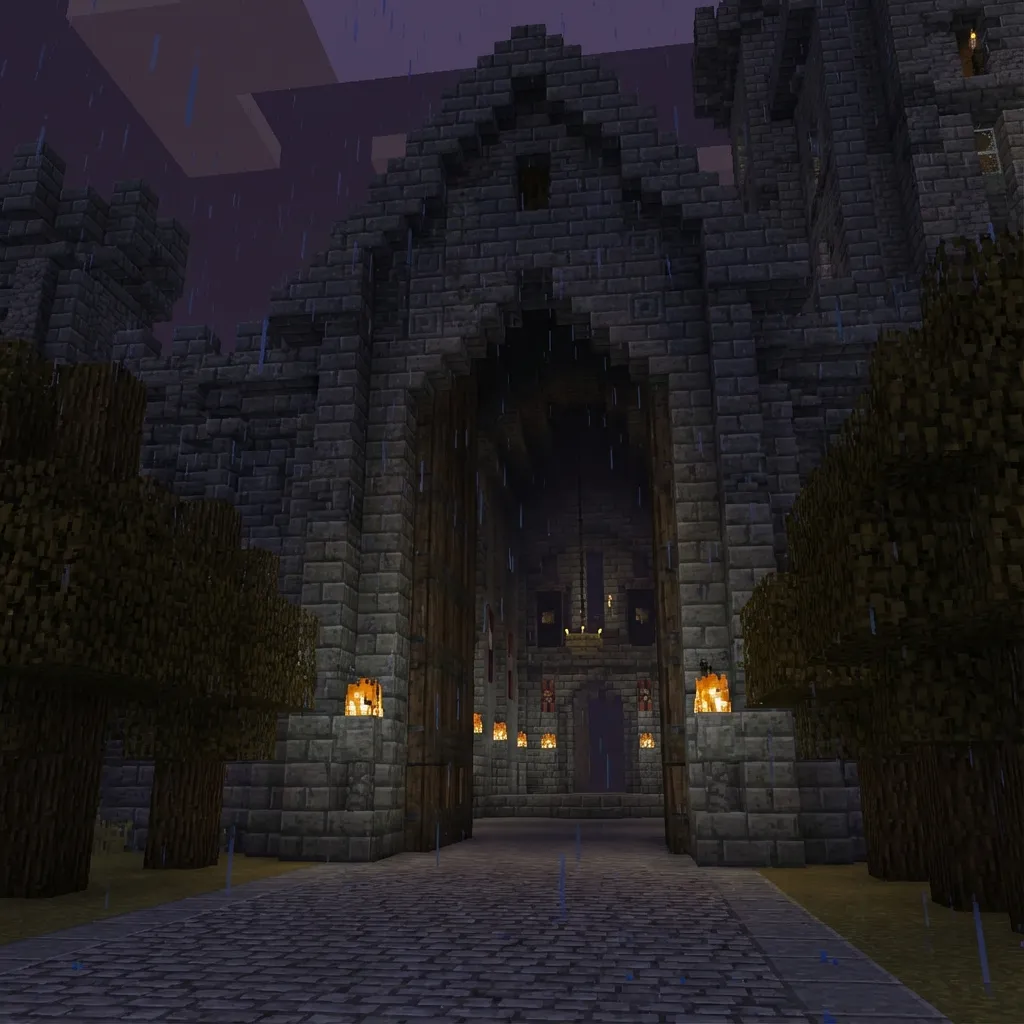
When smoothing vertical arches, apply the Underside Inversion Technique:
- Upside-Down Stairs: Place upside-down stairs on the bottom face of every horizontal overhang block. This fills the 90-degree cavity beneath the curve, turning a square drop into an elegant structural corbel.
- Bottom Slabs for Peak Crowns: On odd-width arches, avoid flat 3-block roofs. Place a bottom slab under the center keystone block so the arch gently crests at its apex.
- For complete structural spanning ratios, refer to our detailed Arches & Curved Bridges Guide.
4. Building Continuous Circular Spiral Staircases
A common search from builders using our generator is how to construct a functional spiral staircase inside circular towers. The key to a clean spiral staircase is matching your center pillar to the circle's parity:
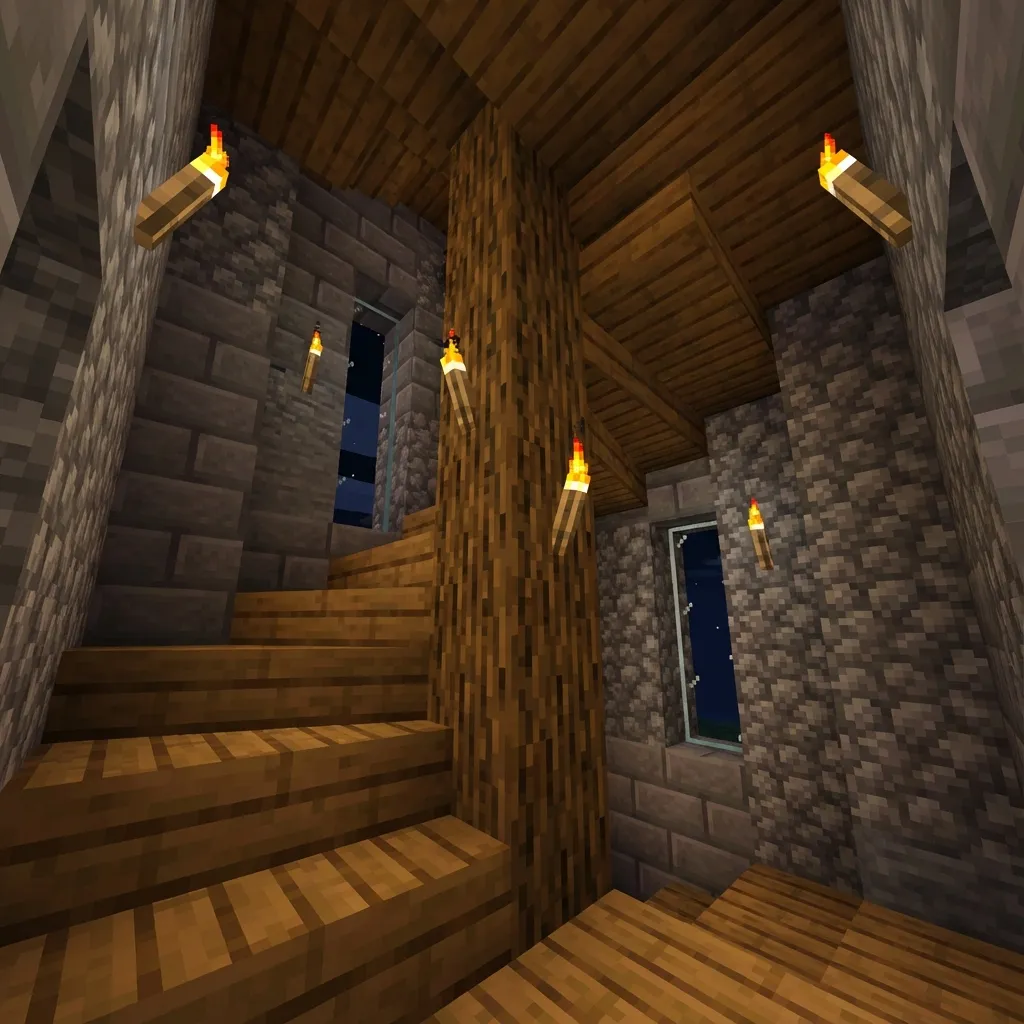
- Odd-Diameter Circles (e.g., 9, 11, 15): Always build a central 1x1 pillar (logs, polished andesite, or stone bricks). Wind 1-block-wide stairs spiraling upward around the center, placing a slab on the corner turn of every 90-degree rotation.
- Even-Diameter Circles (e.g., 10, 14, 16): Use a central 2x2 pillar. This allows 2-block-wide grand staircases with a central light shaft or cascading chain lantern.
- Headroom Tip: Maintain at least 3 blocks of vertical clearance between overlapping stair coils so players can sprint up without bumping their heads.
Summary Checklist for Smooth Curves
- Generate your baseline: Use the MineCircles Generator to get the exact block count and symmetry.
- Replace diagonal extremities: Swap single-corner full blocks with outer-corner stairs.
- Corbel vertical undersides: Place inverted stairs below cantilevered blocks.
- Use matching palettes: Combine Stone Brick Stairs, Smooth Stone Slabs, and Chiseled Stone Bricks to give your curve texture alongside geometric smoothness.
Related Articles
The Science of Voxel Shapes: Mastering Advanced Sphere and Circle Architectures in Minecraft
The definitive guide to voxel geometry, advanced sphere architectures, and optimal block distribution for mega-structures in Minecraft as of 2026.
December 24, 2025How to Build Arches and Curved Bridges in Minecraft
Learn to build stunning arches and curved bridges in Minecraft. Master semi-circle techniques for aqueducts, doorways, and architectural masterpieces.
September 6, 2026Minecraft Circle Size Guide (2026): Exact Diameters for Any Build
2026 Minecraft Circle Size Guide: Find the exact circle diameter for towers, domes, nether hubs, crafter automation rooms, and arenas with block count charts.